Flock’s CEO spoke at “TED2026: All of Us” (Police1 transcript (archive)). Attendees with a $12,500 “Standard” membership (or higher) had applied to hear Langley speak about equity in police surveillance. Instead, he made the case against his own company in three distinct ways.
“Every city has a right”
America is built on principles of freedom, and every city has a right to make that choice. When a community pulls back on public safety they achieve less surveillance, but the people who are made to suffer aren’t the affluent ones, it’s the people who live in neighborhoods where they can’t afford safety…
“[E]very city has a right to make that choice” is Langley flat-out catering to his customer base. The U.S. Constitution — specifically the Fourth Amendment — as well as many state constitutions are intended to constrain government. Local governments don’t have unlimited power.
The other issue here is that “the people who live in neighborhoods” are left out of the conversation and the decision to deploy surveillance entirely. They suddenly discover “LPR” cameras pointed at their basketball court because Flock’s own sales pitch — second image below — says these deployments are a way for departments to get video surveillance without having to go through a public hearing.

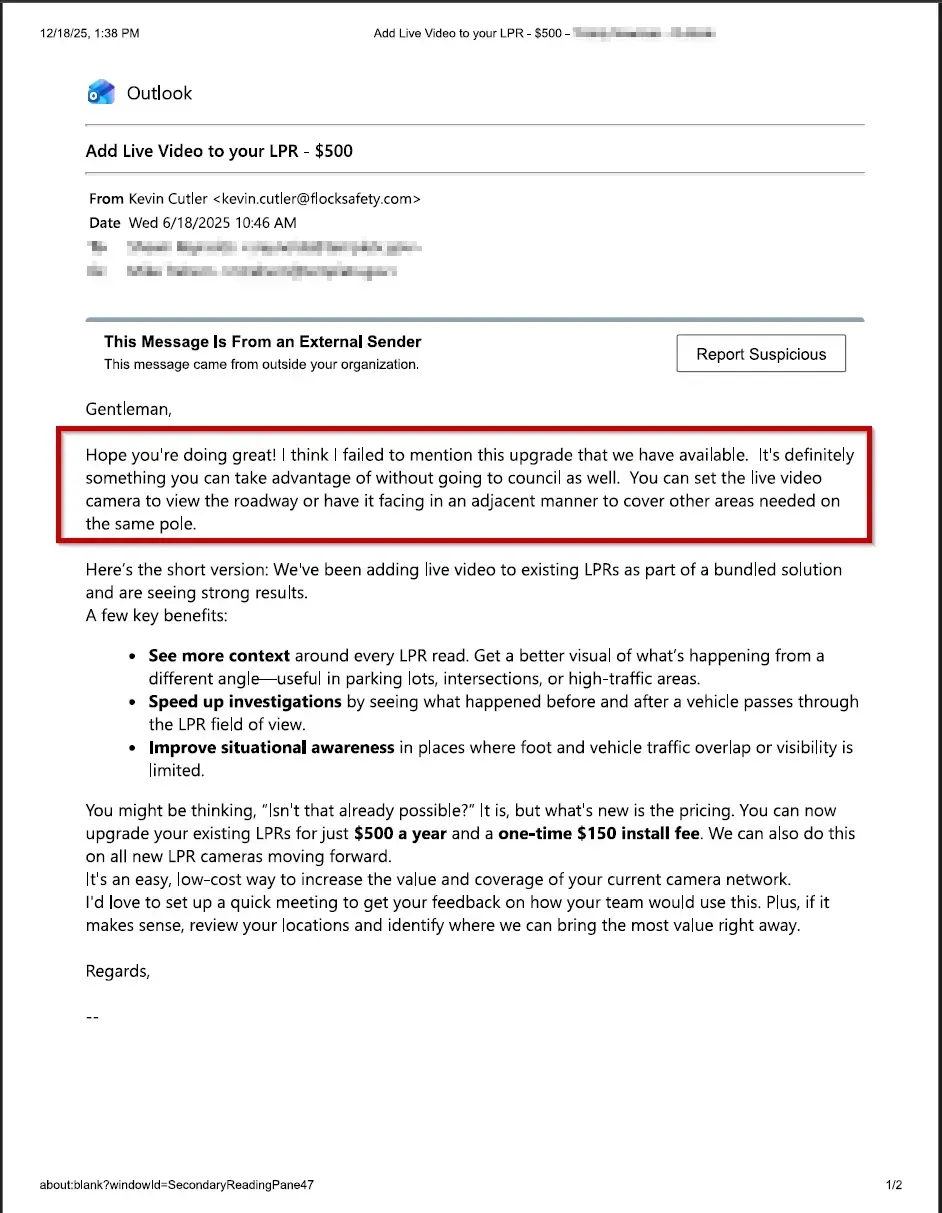
“Flock LPR” cameras are named to trick people into believing they’re license plate readers. Instead, they capture video and data to be fed into a sprawling national system centered on Flock’s “Nova” intelligence product.
In Langley’s world, the cops get to choose. The people aren’t even told.
Safety-as-a-Service (for a Recurring Fee)
South Africa has over 600,000 private security guards. More than its police and military combined. The wealthy live behind nine-foot walls and electric fences. Safety exists, if you can afford it. If you can’t, crime is simply the cost of being alive.
The true hypocrisy, however, is not the price tag for “All of Us”, but the invocation of South Africa’s “pay to stay safe” system. Langley cites it as an example of inequality; at the same time, Flock partners with the South African company Vumacam to profit off the creation of a new era of “digital apartheid” in South Africa.

Vumacam places Flock cameras in affluent suburbs and sells that data to private security contractors. Those corporations, which are even less accountable than the government, in turn sell their services to South Africa’s upper-class.
Langley stands on-stage in feigned indignation, as his $8.4 billion company collects on “the cost of being alive.”
The Digital Standing Army
Langley lauds police forces in other countries and considers the U.S. system of local police to be a “unique problem we have created for ourselves”. He is wrong. It’s not a problem, but a solution.
The founding generation was deeply divided on standing armies. At the time, the local militia kept the peace — professional police didn’t arrive in the U.S. until 1838. A common wisdom was that the more local the militia, the less likely it would be to turn on the people.
What the founders feared from a standing army has arrived in a different form: increasingly militarized and high-tech police. Langley describes his vision as one where any police officer anywhere in the country can “share” and “cooperate” across borders and jurisdictions.
What that means in practice is that any police department in the nation has the capability to dispatch one of Langley’s drones based on reports from his national “Nova” system, fed by hundreds of thousands of his cameras.
Even Hamilton, a proponent of standing armies, warned that nations attached to liberty will, in time, give up freedom for safety — a dynamic that scales down to any institution sold as protection.
Police now believe they depend on Flock. That means its CEO can not only afford safety — he can demand it from the standing army he helped create.
What to do about it
The camera on your corner was approved by someone. Find out who, and when they’re up for election.
- Check whether your city uses Flock.
- Request public records for contracts, data-sharing and demo agreements, and log files.
Public hearings and records requests are the only reason any of this is visible at all. Keep showing up.