In Florida, every time a parent drops off a child at a Hillsborough County school zone, RedSpeed cameras capture continuous HD video of their vehicle. The footage is fed, via RTSP stream, directly into Flock Safety’s national surveillance network where it is processed by Flock’s AI, stored on Flock’s terms, and made searchable by thousands of agencies nationwide.
The contract governing this arrangement contains no data retention policy for the surveillance layer, no restrictions on who can access it, no privacy provisions for the people being filmed, and not even a reference to Flock’s terms of service. The word “privacy” does not appear — except once, regarding credit card processing when subjects pay for the privilege of their surveillance.
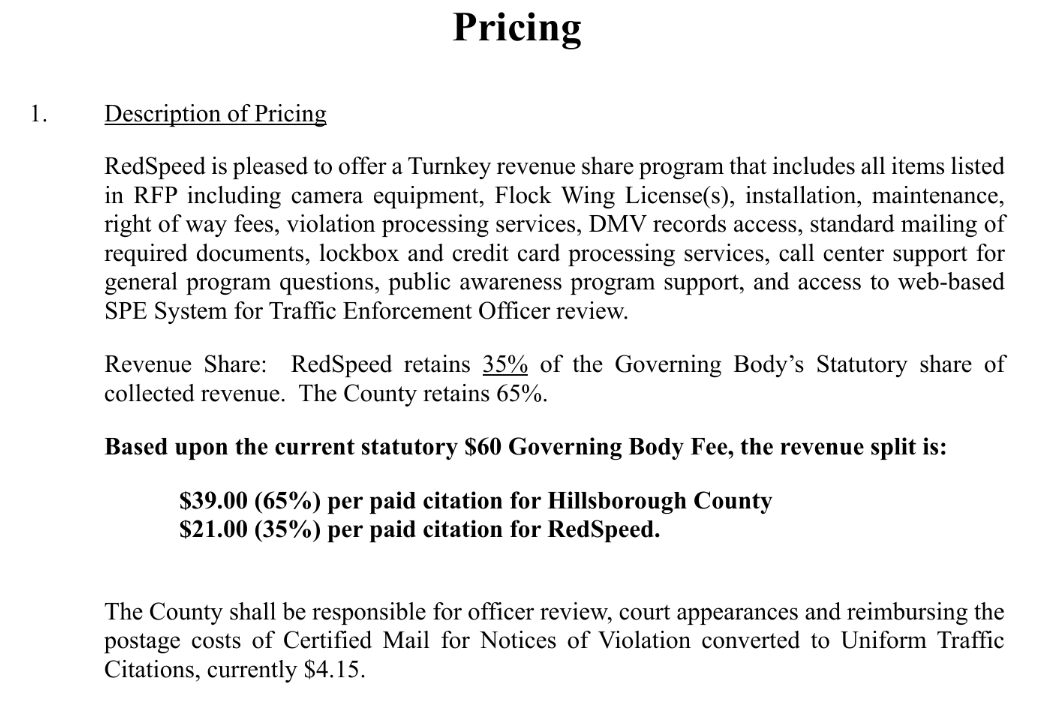
The pricing page of RedSpeed’s winning proposal says it plainly: “Flock Wing License(s) Included.”
What Hillsborough County Bought
In 2024, the Hillsborough County Sheriff’s Office solicited proposals for automated speed enforcement in school zones (RFP 2024-003). RedSpeed Florida won the contract. Its 80-page proposal made the Flock integration central to its pitch.
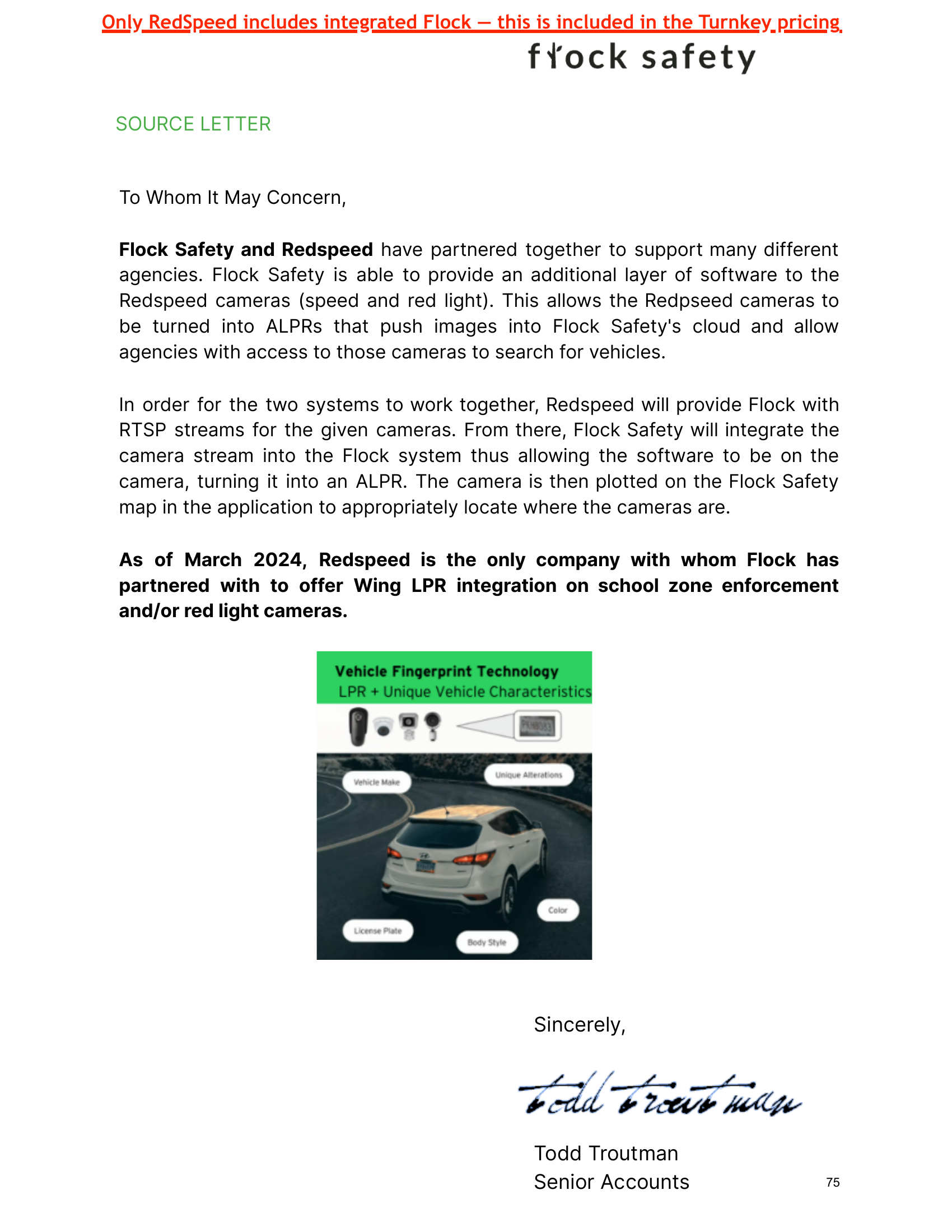
On page 5, a letter on Flock Safety letterhead, signed by Todd Troutman, Senior Accounts, confirms the partnership:
Flock Safety and Redspeed have partnered together to support many different agencies. Flock Safety is able to provide an additional layer of software to the Redspeed cameras (speed and red light). This allows the Redspeed cameras to be turned into ALPRs that push images into Flock Safety’s cloud and allow agencies with access to those cameras to search for vehicles.
…
In order for the two systems to work together, Redspeed will provide Flock with RTSP streams for the given cameras. From there, Flock Safety will integrate the camera stream into the Flock system thus allowing the software to be on the camera, turning it into an ALPR. The camera is then plotted on the Flock Safety map in the application to appropriately locate where the cameras are.
…
As of March 2024, Redspeed is the only company with whom Flock has partnered with to offer Wing LPR integration on school zone enforcement and/or red light cameras.
RedSpeed’s transmittal letter was even more direct:
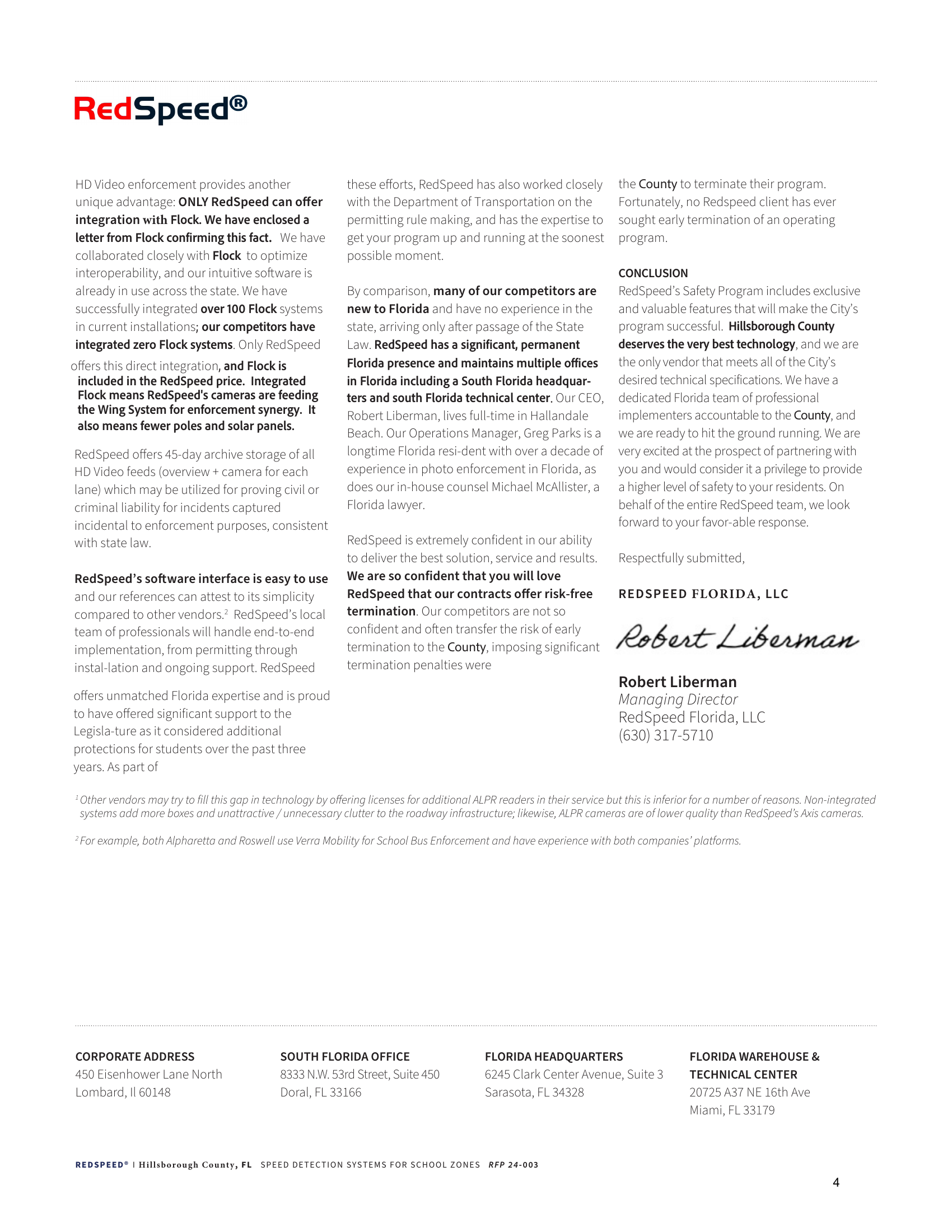
ONLY RedSpeed can offer integration with Flock. We have enclosed a letter from Flock confirming this fact. We have collaborated closely with Flock to optimize interoperability… We have successfully integrated over 100 Flock systems in current installations; our competitors have integrated zero Flock systems. Only RedSpeed offers this direct integration, and Flock is included in the RedSpeed price. Integrated Flock means RedSpeed’s cameras are feeding the Wing System for enforcement synergy. It also means fewer poles and solar panels.
Enforcement. Synergy.
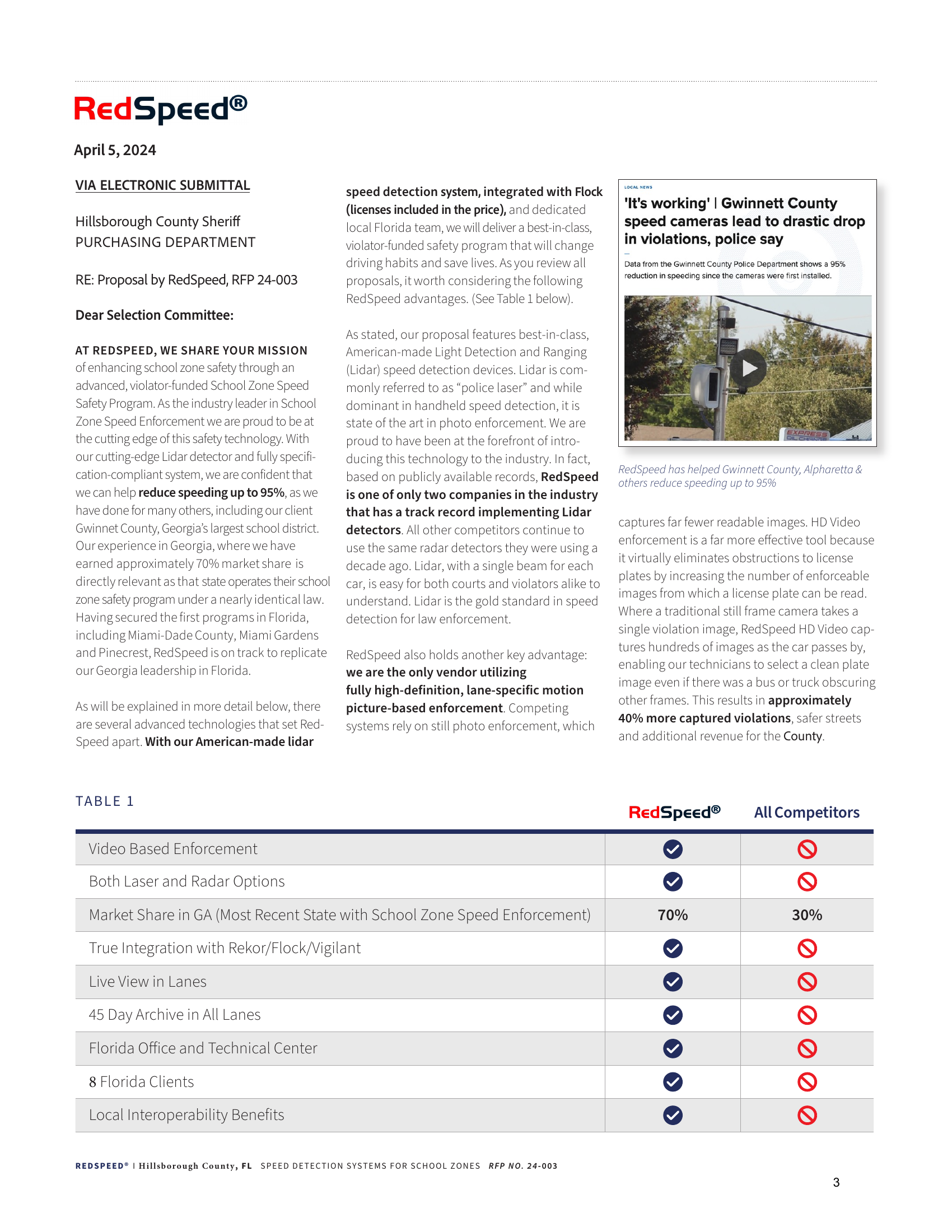
RedSpeed’s proposal includes a competitive comparison table highlighting “True integration with Rekor/Flock/Vigilant” as a checkmark for RedSpeed and a red “denied” for “All Competitors.”
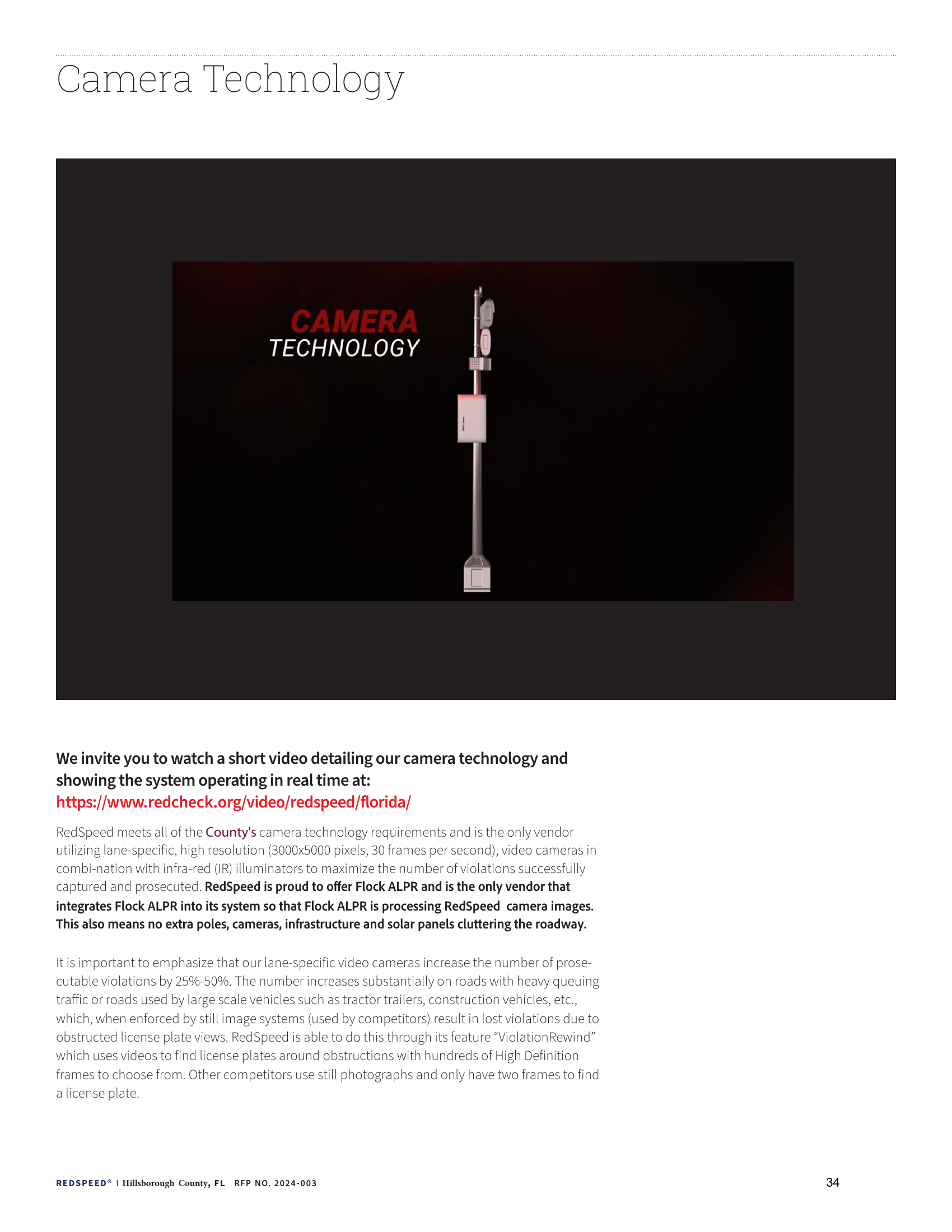
The proposal emphasizes that RedSpeed cameras deliver “lane-specific, high resolution (3000x5000 pixels, 30 frames per second), video cameras” — and that RedSpeed “provides the ability to live stream video from all cameras (no still cameras).” It also states that RedSpeed “provides at least 45 days of storage” and “Flock ALPR at all locations, included in the RedSpeed Price.”
RedSpeed’s stake in all this is straightforward. It offers a “turnkey” service — everything from taking a picture to swiping a credit card — for “35% of the Governing Body’s Statutory share of collected revenue.” In Hillsborough County alone, more than 105,000 violations have been issued since fall 2024, generating over $6 million in paid fines; a local magistrate called it a rip-off.
In Alpharetta, GA, it was structured a little different: the county had to pay 2% extra to give the data to Flock. Maybe that’s Georgia-based Flock’s home field advantage at play.
The Silent Contract
What matters most about the Hillsborough procurement is what the contract doesn’t say.
The HCSO-RedSpeed contract consists of three incorporated documents:
- The RFP solicitation (HCSO RFP 2024-003, 39 pages)
- The draft contract template (11 pages)
- RedSpeed’s proposal (80 pages, including the Flock letter)
The Request for Proposals
The RFP explicitly required ALPR capability (Part D, Section 3):
Qualified, proposing firms must demonstrate competence and experience with Automated Speed Enforcement Systems and Automated License Plate Reader systems
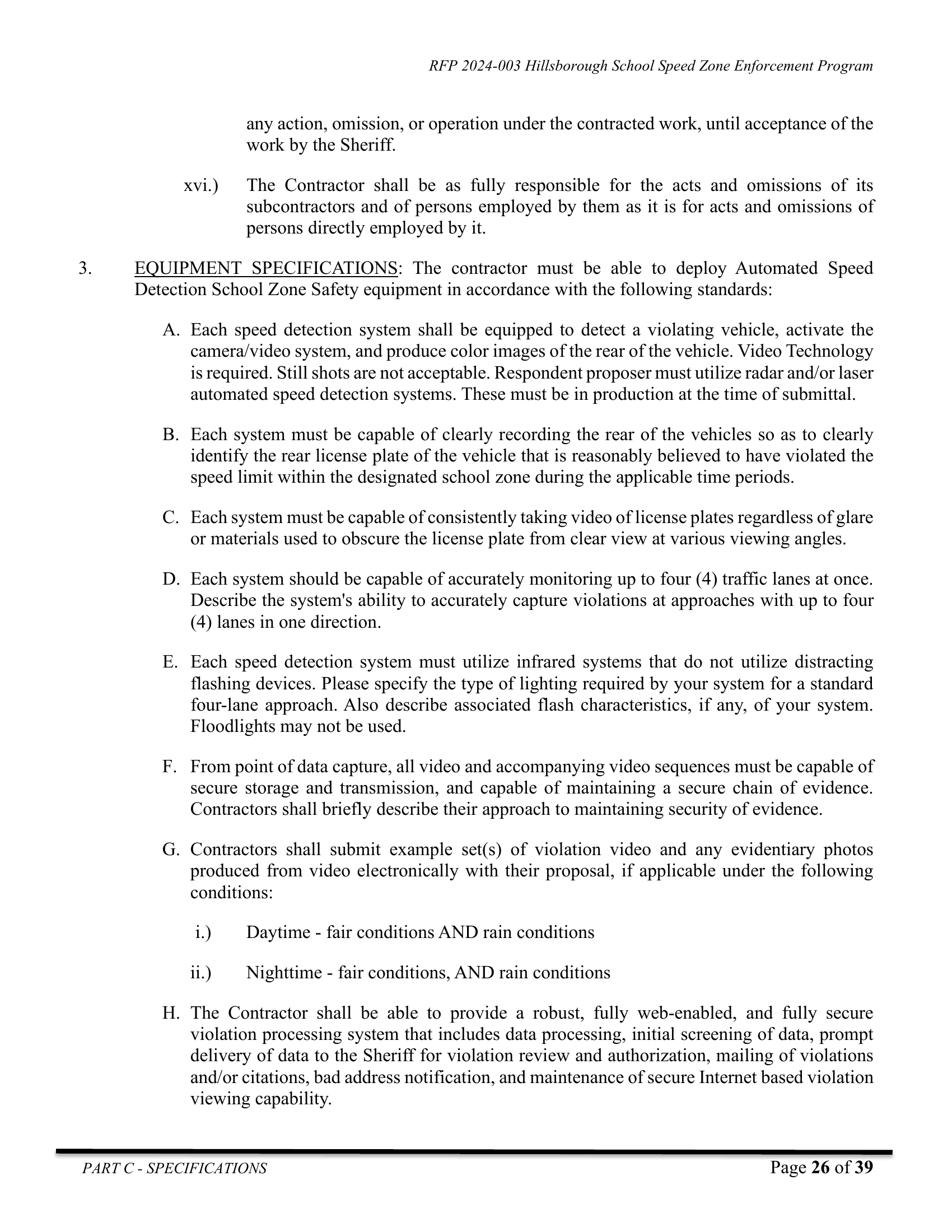
It required video, not stills (Part C, Section 3.A):
Video Technology is required. Still shots are not acceptable. Respondent proposer must utilize radar and/or laser automated speed detection systems.
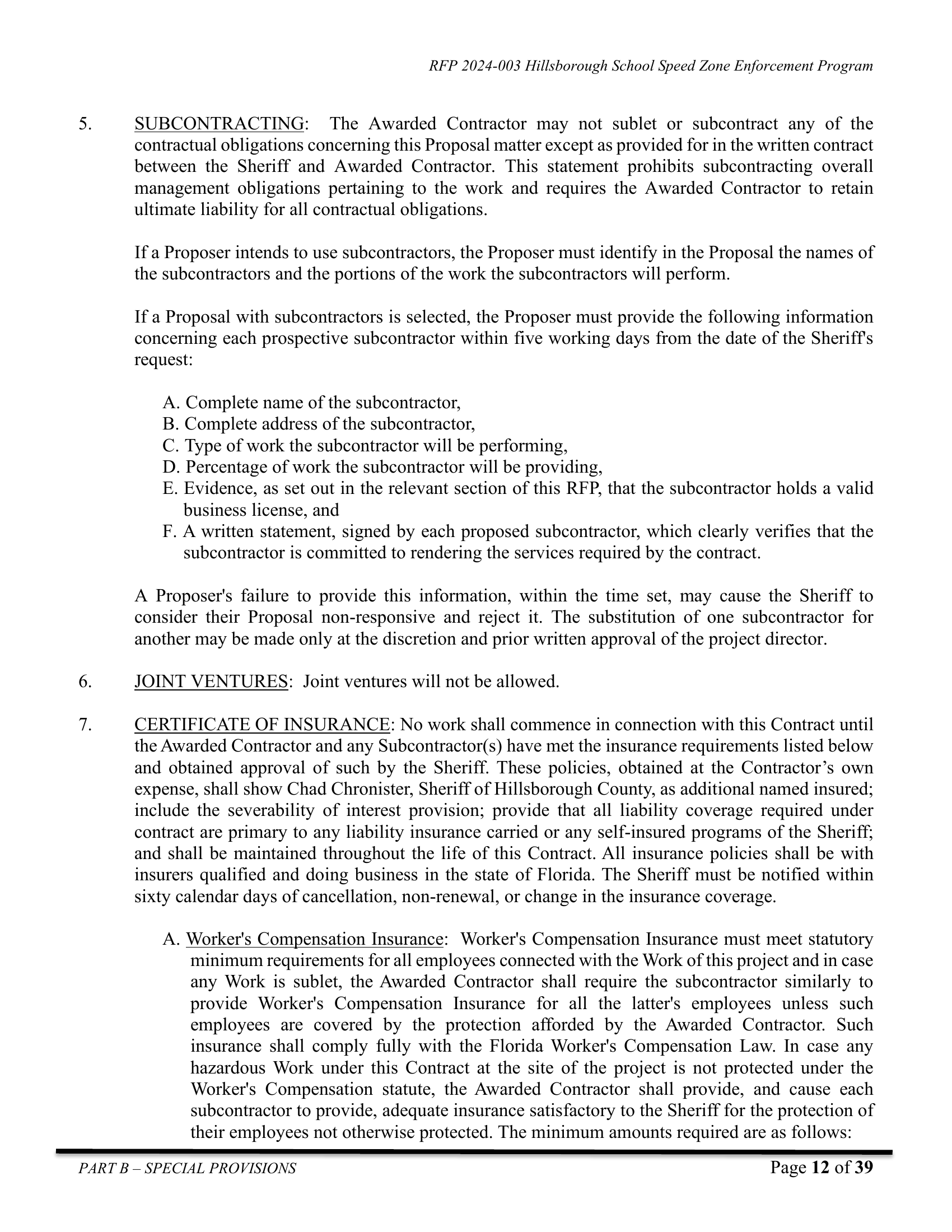
And it required subcontractor disclosure (Part B, Section 5):
If a Proposer intends to use subcontractors, the Proposer must identify in the Proposal the names of the subcontractors and the portions of the work the subcontractors will perform.
What was not in the RFP were any specifications for how ALPR data should be governed, stored, retained, shared, or deleted.
What the draft contract covers
The draft contract is an 11-page template with fill-in-the-blank fields. It covers: term (3 years + three 1-year extensions), insurance requirements, E-Verify compliance, subcontracting (generic), public records obligations (per Florida § 119.0701), indemnification, and confidentiality — but only of “Sheriff Operations” (Section 23).
What the draft contract does NOT cover
- Data retention for ALPR/LPR captures
- Data sharing restrictions (who can access Flock’s system)
- Privacy policy for citizens whose vehicles are scanned
- Flock Safety’s terms of service or Master Service Agreement
- Any reference to Flock’s default data practices (30-day rolling delete, Section 4.3 perpetual anonymized data license, Section 5.3 law enforcement disclosure rights)
- Ownership of ALPR data (distinct from violation/citation data)
- Audit rights over the ALPR system
- Restrictions on out-of-state or federal agency access
- Any framework governing the surveillance layer at all
Nothing in the contract says HCSO gets any rights to the video or the ALPR data. If HCSO wants to access that, they presumably have to do what anyone else can do: pay Flock and ask nicely.
The sheriff’s RFP was specific enough to guarantee the desired outcome. The final tabulation sheet published by HCSO shows RedSpeed with the highest evaluation score of 95.95, ahead of Blue Line Solutions (91.75) and Conduent (77.6).
Wing: The Platform That Turns Any Camera Into a Flock Camera
RedSpeed’s pitch works because of Wing: Flock’s product line for converting third-party cameras into Flock surveillance nodes. The branding is a somewhat confusing patchwork of overlapping names, and Flock has removed several of its Wing-related pages from its website, but the product is still sold and deployed.
The Pitch
In October 2020, Flock Safety announced Wing with a press release headline that said, plainly:
FLOCK SAFETY ANNOUNCES THE WING INTEGRATION TO DISTILL 1000s OF HOURS OF IP CAMERA FOOTAGE INTO SEARCHABLE IMAGES THAT SOLVE CRIME
The subhead: “Software transforms existing IP cameras into cameras that can see like a detective”
Wing takes video from existing cameras — IP cameras, security cameras, traffic cameras — and runs Flock’s AI on it, letting users search for white sedans, unicycles, or people wearing jeans.
Cameras connect via standard RTSP (Realtime Streaming Protocol), a camera standard that’s supported by many commercial surveillance cameras as well as consumer products like doorbells and $35 surveillance cameras.
The Wing Ecosystem
In an August 2025 OMNIA Partners cooperative purchasing pricelist, Wing LPR is listed as: Flock
Safety Wing™ LPR (wing_integration, $3,000/yr per camera): “Video software integration
transforms traditional IP cameras into Flock Safety enabled LPR cameras. Includes Vehicle
Fingerprint™ computer vision and Advanced Search Package (Convoy Analysis, Multi Geo Search, Visual
Search)”
The same catalog lists the Wing product family: Wing Livestream ($500/yr), Wing Replay ($1,000/yr with 7-day footage retention), Wing Gateway 2.0 (8–32 stream hardware at $3,650–$8,250 + subscription), Wing Cloud Live Only ($90/yr), and an Inbound Vehicle Images API ($1,500–$2,500/yr) for ingesting pre-processed plate reads from third-party LPR systems.
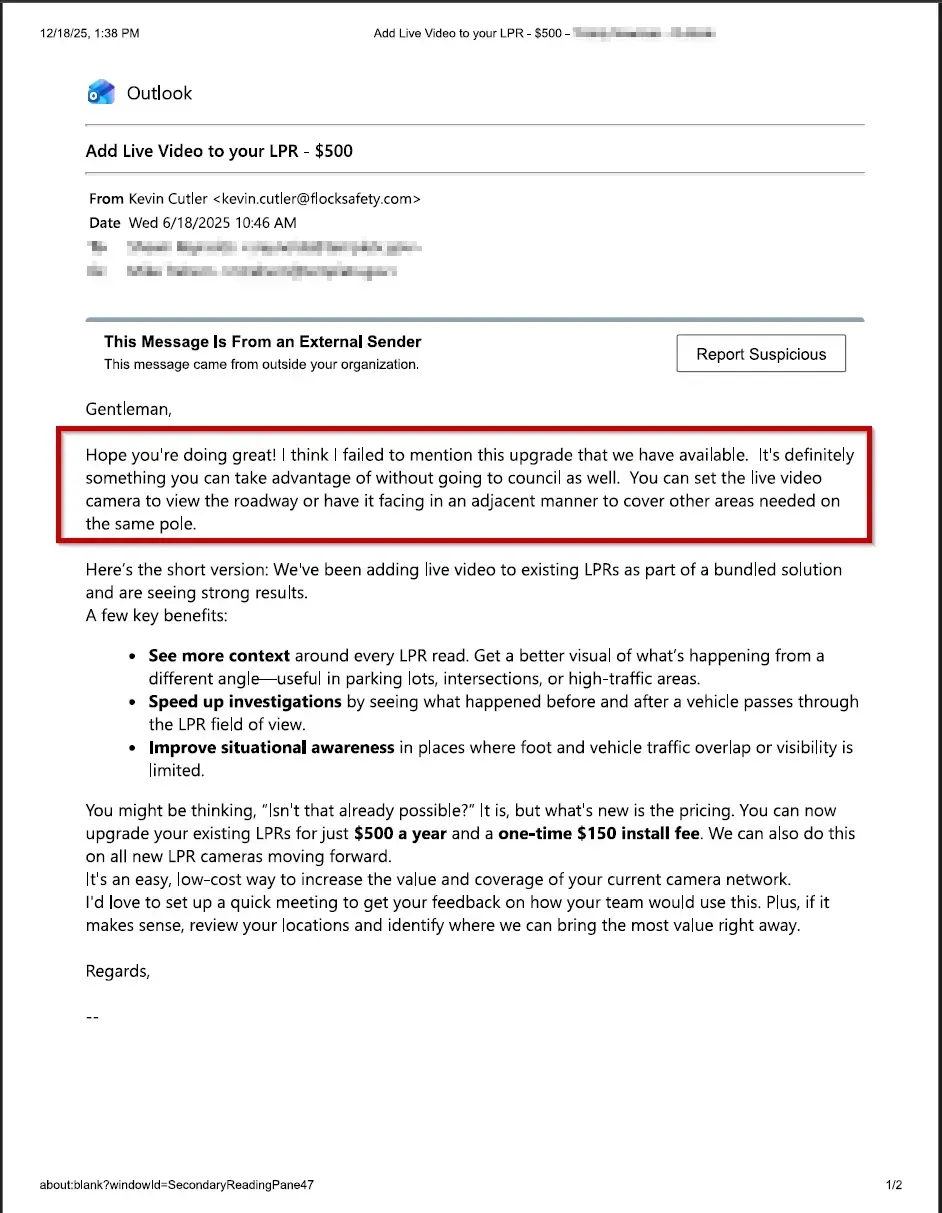
The “Wing Livestream” product price matches the $500 feature that turns Flock’s LPR into live video surveillance — that’s “something you can take advantage of without going to council,” according to Flock Safety’s Kevin Cutler.
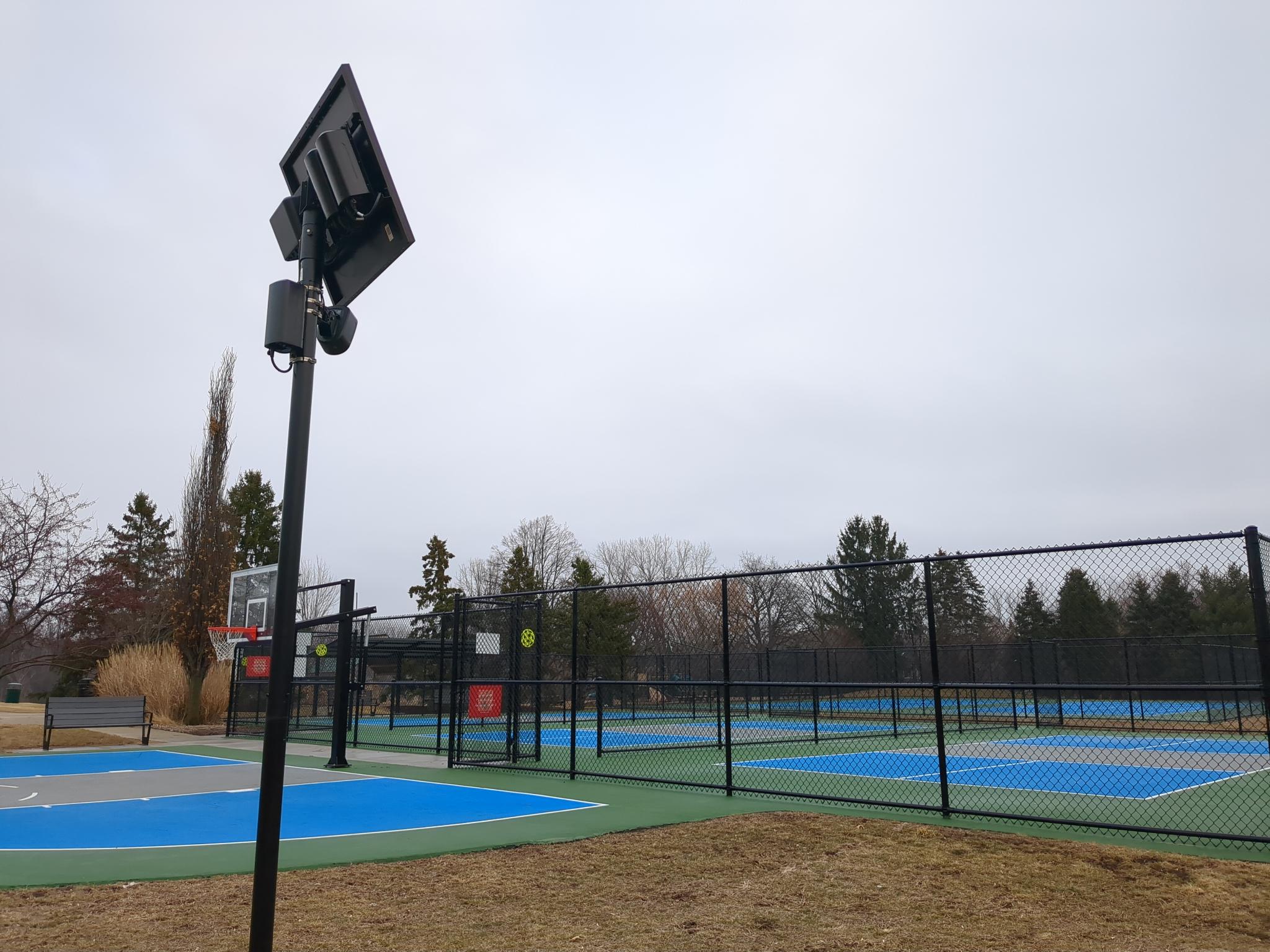
Flock misleadingly tells the public it sells “LPR” cameras — a product name, not a description — while it consolidates its network into a single searchable database.
The network from that Superbowl Ring commercial, promising to find your dog is already deployed nationwide on speed cameras, parking enforcement cameras, and “CCTV” sytems on your basketball and pickleball courts.
Wing in Practice
On June 27, 2025, Flock published a blog post titled “Video Without Limitations: Flock Safety’s Newest Solutions for Law Enforcement” showcasing Wing Gateway 2.0 and Wing Gateway Outdoor.
In the October 2024 webinar (full video), Trevor Pennypacker, Sr. Product Manager at Flock, is excited to tell Flock’s customers that you can connect “parking lots, restaurants, traffic cameras, really anything.”
The City of Bloomington, IL executed an agreement that explicitly includes Wing LPR in its order form:
- “Flock Safety Wing™ LPR — Included — 10 Included”
- “Flock Safety Wing™ VMS — Included — 100 Included”
- “Professional Services — Wing Implementation Fee — $500.00”
The branding, boundaries, and availability of Wing products is all somewhat shifting and murky — from Wing Gateway 2.0 to Wing Cloud to Wing LPR — but the core functionality is what matters: third-party cameras are being turned into Flock nodes, and Flock actively markets and sells that functionality.
The Scan-Everything Architecture
RedSpeed’s cameras are always on during enforcement hours. They capture continuous HD video of every vehicle passing through the field of view — in a school zone, recording parents, teachers, students, buses, and anyone else on the road. “Video Technology is required. Still shots are not acceptable.”
The RTSP stream — all of it, not just violators — is fed to Flock. The Flock letter confirms this is by design: the cameras are “turned into ALPRs that push images into Flock Safety’s cloud and allow agencies with access to those cameras to search for vehicles.” Since then, Flock rolled out FreeForm, its AI-powered search capability that can find people by physical description: “man in blue shirt and cowboy hat,” “dressed in all black clothing and black face mask,” or — as one Dunwoody PD officer tried — “GRINCH.”
Vehicle Fingerprint
The Vehicle Fingerprint technology alone extracts far more than license plates: plate number and state registration, vehicle make, model, color, and body type, missing or covered plates, bumper stickers and decals, roof racks, bike racks, trailer hitches, and aftermarket wheels.
But that’s only part of the picture. Flock CEO Garrett Langley has previously stated that the system indexes everything, filtering only problematic searches — or attempting to filter them, anyway.

Where that data goes
No matter how you feel about red-light or speed cameras as a policy matter, it is hard to justify turning a safety measure for school zones into a surveillance dragnet whose recordings are fed to a private corporation with no contractual restrictions on use. In San Francisco, SFPD’s Flock cameras were searched 1.6 million times by out-of-state and federal agencies — in apparent violation of California law. EFF’s analysis of 12 million Flock searches nationwide found hundreds related to protest activity, immigration enforcement, and discriminatory targeting. A Norfolk, Virginia resident sued after learning Flock cameras had logged his location 526 times in four months.
The Legal Tension
Florida’s prohibition on “remote surveillance”
Florida law explicitly prohibits using school zone speed cameras for “remote surveillance” and restricts the permitted uses of recorded footage:
(15)(a) A speed detection system in a school zone may not be used for remote surveillance. The collection of evidence by a speed detection system to enforce violations of ss. 316.1895 and 316.183, or user-controlled pan or tilt adjustments of speed detection system components, do not constitute remote surveillance. Recorded video or photographs collected as part of a speed detection system in a school zone may only be used to document violations of ss. 316.1895 and 316.183 and for purposes of determining criminal or civil liability for incidents captured by the speed detection system incidental to the permissible use of the speed detection system.
(15)(b) Any recorded video or photograph obtained through the use of a speed detection system must be destroyed within 90 days after the final disposition of the recorded event.
— Fla. Stat. § 316.1896(15)
Two questions that nobody appears to have asked, let alone answered:
First, does feeding the full RTSP stream to Flock — where it is processed by AI, matched against vehicle databases, and made searchable by thousands of agencies for purposes wholly unrelated to speed enforcement — constitute “remote surveillance” under the statute? The statute defines what is not remote surveillance (evidence collection for speed violations, PTZ adjustments), but the legislative history does not address third-party AI processing of the video feed.
Second, the statute requires destruction of recorded video within 90 days of final disposition, and vendors must certify destruction annually. But once the RTSP stream enters Flock’s system, it is processed into Vehicle Fingerprint data, plate reads, and searchable metadata governed by Flock’s own retention policies — not the county’s.
Altumint, a competing speed camera vendor in Florida, hinted at a loophole when it drew a distinction explicitly. Its chief revenue officer told the Independent Florida Alligator in March 2026 that Altumint’s cameras “only capture a license plate if the vehicle is speeding more than 10 miles over the speed limit,” whereas RedSpeed’s Flock ALPR cameras “can document every license plate that passes by.” He added: “Even in a school zone, you could be going 25 in a 15 … but I can’t capture that plate. ALPR can capture that plate.”
Whether derivative data (plate reads, AI-extracted vehicle descriptions) qualifies as “recorded video or photograph” under the statute is untested. The statute’s drafters were contemplating a camera vendor that stores and deletes footage. They were not contemplating a speed camera sending data to a second vendor that ingests the same stream in real time and converts it into a permanent surveillance record.
No Florida court has addressed either question. No Attorney General opinion appears to exist. The statute was enacted in 2023 (HB 657). Florida is one of RedSpeed’s biggest markets.
What Flock Tells Everyone Else
Across dozens of municipal FAQ pages and Transparency Portals, Flock provides standardized language:
Flock Safety cameras are not used to enforce traffic violations such as speeding, running red lights, or other moving violations. The cameras do not capture vehicle speed and are solely used for investigative purposes related to public safety.
Technically, that appears to be true. “Flock Safety cameras” are not used for traffic enforcement — RedSpeed’s cameras are. But they operate on Flock technology, within the Flock network.
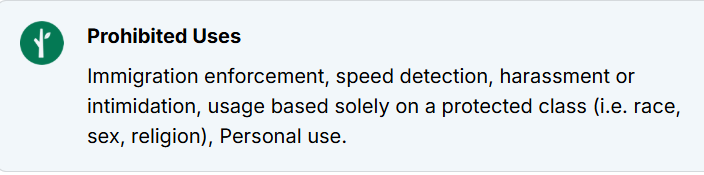
Flock’s Transparency Portals go further. The Thomasville, GA PD portal explicitly lists “speed detection” as a prohibited use of Flock technology, and confirms that the system is used “for law enforcement purposes only.”
Meanwhile, RedSpeed’s speed detection cameras are feeding RTSP streams directly into this same network via Wing LPR. Data from a speed detection system enters a platform that lists speed detection as a prohibited use.
It’s not our cameras
The Flock letter on page 5 of the HCSO proposal says Flock provides “an additional layer of software to the Redspeed cameras (speed and red light).” The transmittal says “Integrated Flock means RedSpeed’s cameras are feeding the Wing System for enforcement synergy.” The pricing says “Flock Wing License(s)” are included in a speed enforcement contract.
Flock’s defense rests on a technicality: its cameras don’t capture speed; its technology is merely consuming the video feed from someone else’s speed cameras and processing it for entirely different purposes. Whether that distinction will satisfy a legislature, or the parents whose children are being filmed remains to be seen.
The Partner Page
RedSpeed claimed to be the only Flock-integrated vendor for school zone enforcement as of March 2024. As of March 2026, Flock’s partner program page lists several other automated traffic enforcement companies as “Channel Providers.”
Maybe Flock gave them different territories, outside school zones.
The Broader Pattern
The GSP Ticket
On December 26, 2025, Georgia State Patrol ticketed a motorcyclist for holding a cell phone while riding. The citation read: “CAPTURED ON FLOCK CAMERA 31 MM 1 HOLDING PHONE IN LEFT HAND.”
GSP called it a “unique circumstance.” The ticket was dropped in court. EFF described the incident as an example of the mission creep it has “long warned about” with surveillance infrastructure.
It is the kind of one-off incident Flock can dismiss. Its long-standing RedSpeed partnership is not.
Brookhaven, GA
In Brookhaven, GA’s words, RedSpeed cameras feed “real-time alerts” into “Brookhaven’s existing License Plate Reader (LPR) platform to identify sex-offenders, protective orders, and wanted persons for increased safety in school zones.”
Even if you are a concerned parent thinking sounds like a good idea, the practical value of such a system is questionable at best. Police are not going to act on these “real-time alerts” each time anyone under a protective order — many of which are not the result of any criminal activity, let alone any criminal activity involving children — drives through a school zone.
The system’s real-time capabilities, like watchlists and speeding tickets, are secondary. The real value is in gathering massive amounts of videos and photos of everyone entering a school zone — parents, teachers, students.
RedSpeed’s strong marketing emphasis on video quality (15 Megapixels, 30 frames per second), raises questions as well. If a regular Flock LPR, which RedSpeed says is of “lower quality,” is accurate enough to perform ALPR and create evidence, how is a camera where you can count the pimples on your middle schooler’s nose an advantage?
The point isn’t better traffic enforcement: it’s high-definition video surveillance.
Tampa’s Piggyback
In Hillsborough County’s seat, Tampa, RedSpeed scored third on an RFP but the council unanimously voted for the contract anyway. Creative Loafing Tampa noted that there was “no indication in the backup materials why the third place proposal was chosen.”
Before the vote, Creative Loafing reported, “several council members noted they spoke with the Chief and were assured the data wouldn’t be inappropriately shared.” Council member Lynn Hurtak said “the only time they are allowed to use this technology is to share it with other agencies when they have an open case.”
If that’s the policy, it isn’t in the sheriff’s contract.
Making the Quiet Part Loud
Flock quietly sells Wing integration in the background while partners like RedSpeed bundle it for easy consumption by sheriffs and police chiefs. Contracts are kept minimal — no data governance, no privacy language, no mention of the surveillance layer. The RFP asks for ALPR. The proposal delivers Flock. The contract says nothing about what Flock does with the data. Nobody on city council asks, because the pitch is about school safety and the cameras are “violator-funded.”
Across the country, communities have begun pushing back against Flock’s surveillance network. Austin, Cambridge, Eugene, Evanston, and dozens of other jurisdictions have canceled, paused, or refused to renew Flock contracts after audits revealed immigration enforcement access, discriminatory searches, and data sharing that violated state law.
Those fights were about Flock cameras communities knew they were buying. The unified Wing network is different: residents are now told they’re getting school zone speed cameras, but the video is being routed into a national surveillance network with no contractual guardrails; or they’re being told they’re getting license plate readers only to find them watching them shoot hoops.
Flock, RedSpeed, the Sheriff, and elected officials are tired of the push-back. They’re actively restructuring to keep the public under surveillance and in the dark. We can’t let them.